Who Are Pakistan's Hindu Minority Refugees?
Pakistani Hindu minority refugees are families — mostly from Sindh, Pakistan — who fled religious persecution, economic marginalisation and a lack of basic rights, crossing into India through official and unofficial routes. They arrived in Rajasthan's border districts seeking a better life. What they found instead was a bureaucratic limbo that has now stretched, for many, into decades.
They are not classified as refugees under India's domestic law — India has not signed the 1951 UN Refugee Convention. Without a formal legal framework, their status is ambiguous, their rights uncertain, and their access to government services severely limited.
The Wait for Citizenship
To obtain Indian citizenship, a Pakistani Hindu refugee must wait a minimum of seven years under the Citizenship Act, 1955. During this time:
- They are issued Long-Term Visas (LTVs), not citizenship
- LTVs require renewal every one to five years — a costly and bureaucratically burdensome process
- Without citizenship, they cannot own agricultural land, access most government welfare schemes, or vote
- Children born in India to non-citizen parents often inherit this limbo
- Many have waited far beyond the statutory seven years, still without citizenship
UJAS — through its Nagarikta Adhikar campaign — has helped over 13,000 refugees secure Indian citizenship since 2005, by working with District Magistrates and advocating directly with state and central government.
"For fifteen years, I woke up every day not knowing if I belonged here. My children were born here, grew up here — but on paper, they were from nowhere. When UJAS helped us get citizenship, I felt, for the first time, like I was standing on solid ground."
— A refugee family member, Jodhpur district (name changed for privacy)
The Scale of Displacement in Rajasthan
UJAS works across approximately 1,000 settlements in seven western bordering districts of Rajasthan — Jaisalmer, Jodhpur, Barmer, Jaipur, Jalore, Bikaner and Sri Ganganagar. The majority of Pakistan's Hindu minority refugees in India are concentrated in these districts.
Children Without a Country
Children of non-citizen refugees face a compounded vulnerability. Born in India, but without citizenship, they navigate their formative years in a bureaucratic no-man's-land.
The consequences are severe and often lifelong:
- School access — government schools may require Aadhaar or documents that non-citizen families cannot produce
- Health exclusion — without Aadhaar-linked benefits, families are excluded from public health schemes
- No legal identity — children may grow up without birth certificates, making them stateless in practice
- Early marriage risk — without economic security or education, girls from refugee families face higher rates of early marriage
- Psychological burden — growing up without belonging creates lasting anxiety and low self-worth
Why Women Are Disproportionately Affected
Women in refugee communities carry an invisible double burden. They manage households, raise children and support family income in an environment of economic precarity — often without identity documents of their own, and with limited access to healthcare or legal protection.
Women who are widowed or separated face acute vulnerability: no property in their name, no citizenship documentation, and no access to the welfare schemes that could provide a safety net. UJAS's women's programmes — including the Handicraft and Embroidery Centres funded by the District Industrial Center, Rajasthan — give women economic independence and a community of solidarity.
"I had no documents. No income. No one to help me. When I joined the crafts centre, I learned a skill, I earned money, and I found sisters. That is what UJAS gave me."
— A participant, UJAS Crafts Centre, Jodhpur (name changed for privacy)
What the Law Says
India's legal framework on citizenship and refugee welfare is strong in intent but inconsistently implemented, leaving many families in prolonged uncertainty.
The Citizenship Act, 1955
Pakistan's Hindu minority refugees can apply for Indian citizenship under Section 5 (registration) after residing in India for at least seven years. However, delays in processing, documentation barriers, and administrative inconsistency mean that many families wait far longer. UJAS advocates directly with District Magistrates and the Ministry of Home Affairs to accelerate these cases.
The Citizenship Amendment Act, 2019
The CAA provides an expedited pathway to citizenship for Hindu, Sikh, Buddhist, Jain, Parsi and Christian minorities from Pakistan, Afghanistan and Bangladesh who entered India before December 31, 2014. While the CAA has expanded options for some, UJAS continues to support families who do not meet its specific criteria and need assistance through the conventional citizenship route.
What UJAS Is Doing About It
Founded by Hindu Singh Sodha — himself a migrant who lived through the displacement and injustice these communities face — UJAS has built a comprehensive, community-centred approach to refugee rights across Rajasthan.
1. Citizenship Advocacy
UJAS field teams work directly with refugee families to compile documentation, navigate the citizenship process, and advocate with District Magistrates for timely processing. Since 2005, over 13,000 families have received citizenship through this work.
2. Healthcare Access — Dhaat Initiative
The Dhaat Healthcare Initiative connects approximately 4,000 Pakistani Hindu refugees (70% non-citizen) in Jodhpur with the local health system. Focus is placed on women, children and the elderly, for whom barriers to healthcare access are highest.
3. Education Support
UJAS facilitates school enrolment for refugee children, navigating the documentation challenges that would otherwise exclude them. The School Education Support Project has grown enrolment from 114 to 140 students, with 90%+ attendance rates.
4. Livelihoods — Handicraft & Embroidery Centres
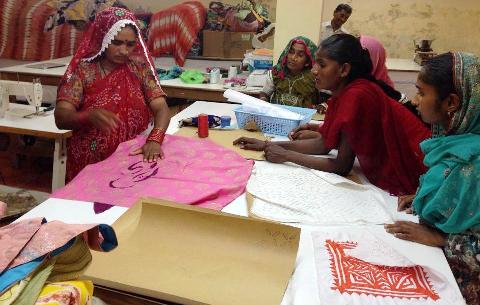
UJAS's Handicraft and Embroidery Centres — funded by the District Industrial Center, Rajasthan State Government — provide Pakistani women migrants with skills in block printing, Bandhani, Gota Patti embroidery and tailoring, creating pathways to economic independence and dignity.
5. Advocacy & Systemic Change
UJAS presents evidence to state and national policy forums, pushing for faster citizenship processing, stronger refugee welfare frameworks, and data-driven improvements to support the communities we serve. We believe the system itself must change — not just the outcomes for individual families.